

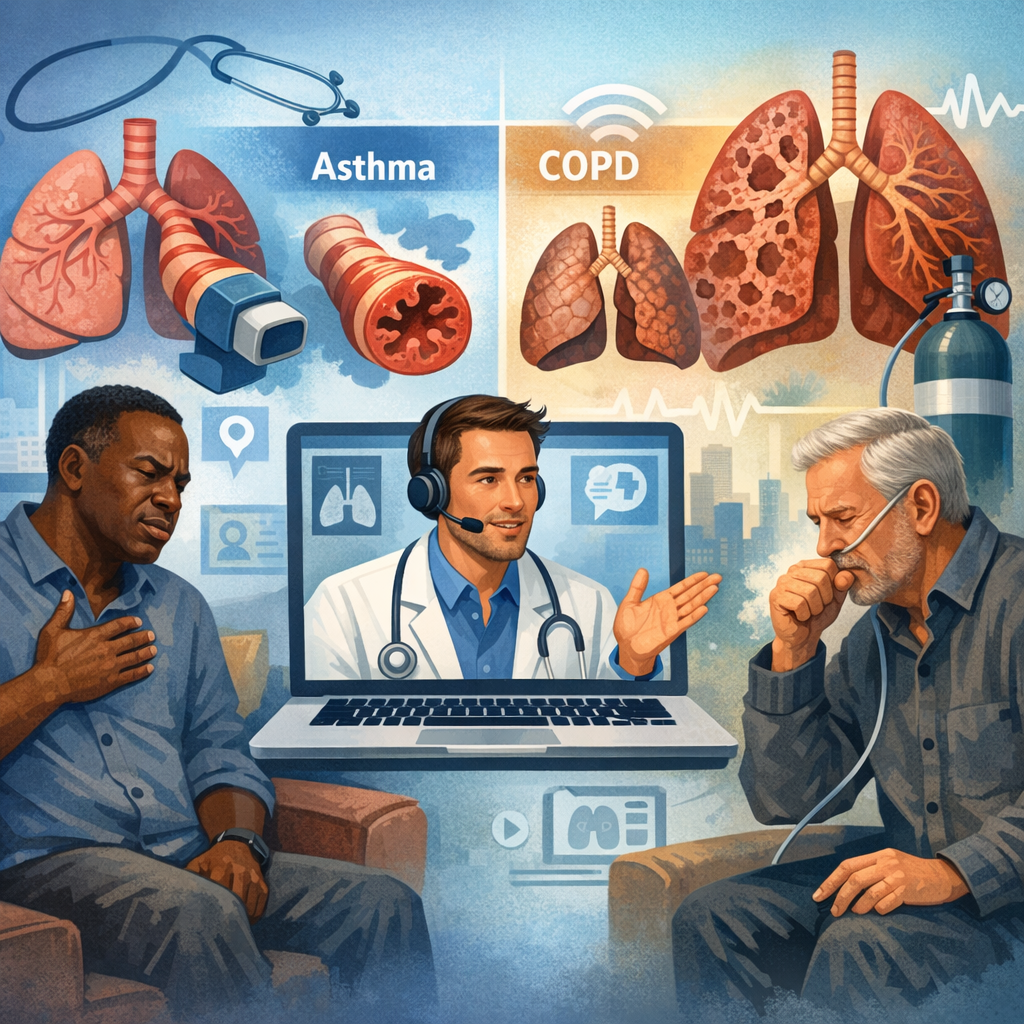
### Understanding the Overlap: Distinguishing Asthma Symptoms from COPD in Men’s Health Telemedicine Consultations
#### Introduction to Respiratory Challenges in Telemedicine
Respiratory complaints are among the most common reasons men seek medical advice, both in traditional face-to-face settings and through men’s health telemedicine consultations. Asthma and chronic obstructive pulmonary disease (COPD) share symptoms such as cough, wheezing, shortness of breath, and chest tightness. However, proper differentiation is crucial since management strategies, medication choices, and monitoring differ significantly. In a virtual setting, clinicians face unique challenges like limited physical exams, heavy reliance on patient history, and potential underreporting of lifestyle factors, such as smoking. This article explores methods to effectively distinguish asthma from COPD remotely, ensuring optimal health outcomes for male patients.
#### Unraveling the Similarities Between Asthma and COPD
Both asthma and COPD are obstructive lung diseases characterized by airflow limitation but differ in their pathophysiologies and clinical progressions. Overlapping features include:
– **Wheezing**: High-pitched whistle sounds during exhalation.
– **Chronic Cough**: Persistent cough, sometimes with sputum.
– **Dyspnea**: Breathlessness that worsens with exertion.
– **Chest Tightness**: A constricted feeling in the chest.
For men, particularly those working in high-risk occupations like welding or mining or with a history of smoking, these shared symptoms can lead to a condition sometimes called Asthma-COPD Overlap (ACO). Identifying these features during telemedicine consultations is essential for targeted questioning and remote assessment.
#### Key Distinguishing Features Between Asthma and COPD
1. **Age of Onset and Symptom Variability**
– Asthma often begins in childhood or early adulthood with symptoms that vary over hours or days.
– COPD typically develops after age 40 and progresses slowly with more constant airflow limitation.
2. **Triggers and Reversibility**
– Asthma symptoms are usually triggered by allergens or physical activity and improve rapidly with treatments like bronchodilators or corticosteroids.
– COPD exacerbations are often due to infections or pollution and may only partially respond to bronchodilators.
3. **Smoking History and Risk Factors**
– A significant smoking history (more than 10 pack-years) strongly suggests COPD, although non-smokers can develop it from sources like biomass fuel exposure.
– Asthma patients might smoke, but their symptoms show marked variability and identifiable triggers, often indicative of asthma.
4. **Sputum Production**
– Chronic sputum production is more typical of COPD, especially in cases with chronic bronchitis.
– Asthma may cause mucus production during attacks, but ongoing sputum production is less common.
#### The Importance of Accurate Diagnosis in Telemedicine
While telehealth offers convenience and accessibility, it poses several challenges, such as the lack of in-person lung examination and potential misinterpretations of patient descriptions. Male patients might downplay symptoms due to societal norms, leading to delayed care. Misdiagnosis can lead to inappropriate treatment—for instance, using inhaled corticosteroids for COPD can increase pneumonia risk. A structured approach to history-taking and remote monitoring is indispensable for accurate differentiation in telemedicine.
#### Tools and Strategies for Telemedicine Consultations
1. **Detailed, Structured Questionnaires**
– Use validated tools like the Asthma Control Test (ACT) or COPD Assessment Test (CAT) adapted for telehealth.
– Include questions about symptom changes, trigger identification, and activity limitations.
2. **Remote Peak Flow and Spirometry**
– Patients can use home peak flow meters, tracking readings over two weeks. Significant variability (over 20%) might suggest asthma.
– Handheld spirometers uploading data via apps can provide objective measurements when available.
3. **Video-Assisted Respiratory Assessment**
– Observe breathing patterns during telehealth calls, such as the use of accessory muscles.
– Request video recordings of symptoms, like wheezing after exercise.
4. **Medication Response Trials**
– Trials of inhaled bronchodilators and, if suitable, short-term inhaled corticosteroids offer insights based on symptom improvement.
5. **Smoking Cessation and Environmental History**
– Thoroughly review occupational exposures and smoking habits.
– Provide remote coaching for smoking cessation through digital programs or apps.
#### Recommendations for Patients
– **Maintain a Symptom Diary**: Log daily peak flow readings and triggers, sharing them during telemedicine appointments.
– **Prepare a Medication List**: Include all remedies and previous inhalers, noting their effectiveness.
– **Record Personal Videos**: Capture episodes of breathlessness to aid remote assessment.
– **Be Honest About Lifestyle Factors**: Fully disclose medical history and lifestyle elements to your provider.
– **Follow-Up Regularly**: Schedule telehealth check-ins every 3–6 months or as needed.
#### Conclusion: Tailoring Treatment Through Telemedicine
Distinguishing asthma from COPD in telemedicine consultations demands a systematic, patient-centered approach. By employing structured questionnaires, remote monitoring tools, and thorough history-taking, clinicians can overcome virtual care’s limitations. Accurate diagnosis leads to tailored treatment plans, improving symptom control, reducing exacerbations, and enhancing quality of life. Telemedicine can empower male patients juggling various commitments, provided both patient and provider engage in clear communication and diligent monitoring.