

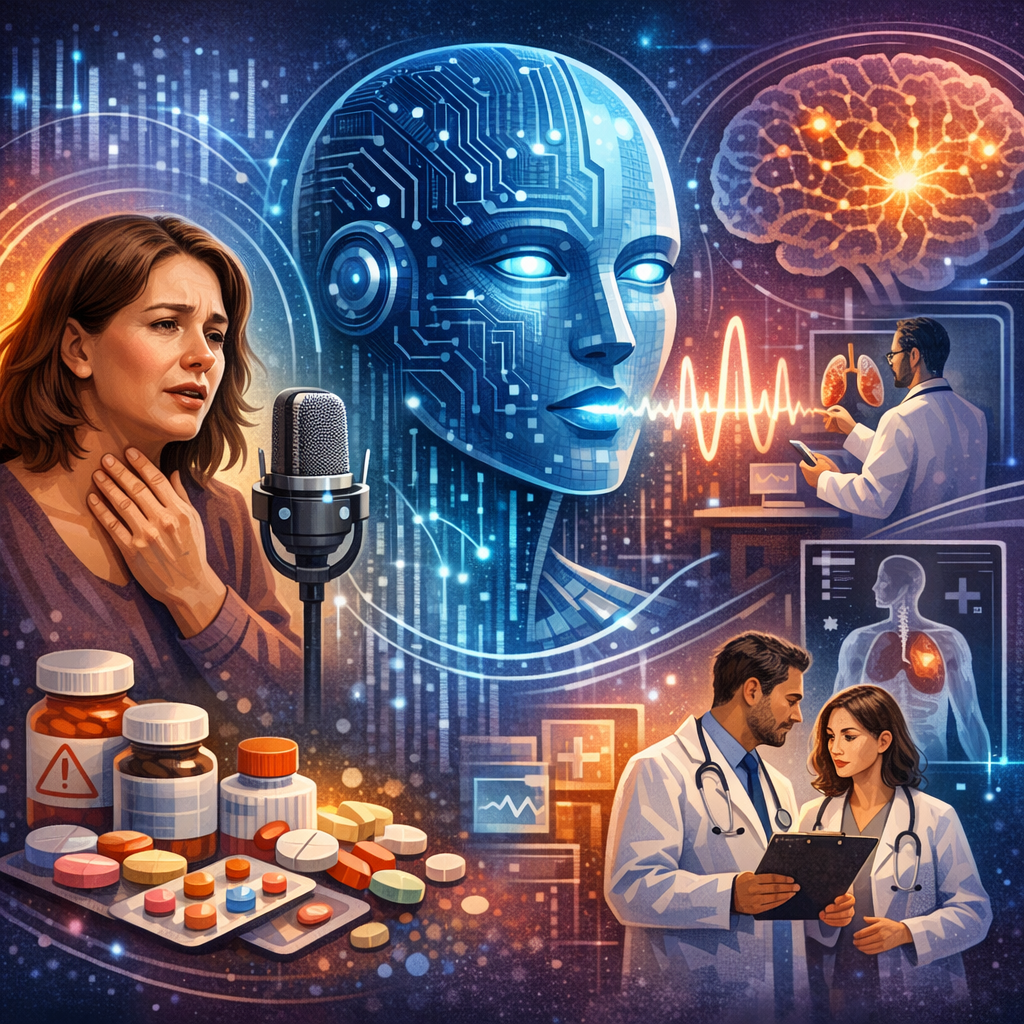
### Unraveling Symptoms: Medication Side Effects vs. Underlying Conditions
Differentiating medication-induced side effects from symptoms of underlying medical conditions remains a persistent challenge in clinical practice. Patients often report issues like fatigue, tremors, speech changes, or mood swings, which could be attributed either to their prescribed medications or to disease progression. Misattributing these symptoms can lead to inappropriate treatment adjustments, unnecessary diagnostic tests, or further deterioration of the patient’s condition. According to Dr. Jane Smith, a prominent neurologist, “Early and accurate differentiation is critical to avoid cascading diagnostic errors.” In recent years, AI-powered voice analysis has emerged as an innovative, non-invasive tool to assist clinicians in unraveling this diagnostic puzzle.
### Navigating the Complexity of Symptom Attribution
The task of distinguishing between medication side effects and illness symptoms is delicate. Many modern therapeutics, such as antidepressants and antiparkinsonian medications, carry a broad range of side effects. For instance, antidepressants can lead to vocal changes, while antiparkinsonian drugs may induce dyskinesia, subtly altering speech rhythm. Adding to the complexity, neurological disorders like Parkinson’s disease, multiple sclerosis, or myasthenia gravis naturally affect motor control, including the vocal apparatus. Dr. Emily Johnson explains, “Subjective symptom reporting often falls short of capturing the nuanced differences crucial for accurate diagnosis.” Typically, simple self-reports and routine examinations may not effectively capture these distinctions, leading to a trial-and-error approach or the need for costly diagnostic tests.
### AI-Powered Voice Analysis: A Step Forward in Diagnosis
AI-powered voice analysis employs machine learning algorithms to analyze extensive datasets of speech recordings from diverse patient populations. These tools quantify acoustic features like pitch, jitter (frequency variation), shimmer (amplitude variation), speech rate, pause frequency, and spectral characteristics. When a new patient provides a short voice sample—often through a smartphone app—the algorithms compare these acoustic features to established patterns associated with specific side effects or disease changes. A probability score is generated, indicating whether the vocal anomalies are more likely due to medication effects or disease progression.
#### Key Steps in the AI Voice Analysis Process
1. **Data Collection**: Large repositories of anonymized speech samples are gathered from patients with well-documented diagnoses and treatment histories.
2. **Feature Extraction**: Advanced signal processing techniques dissect audio files into measurable acoustic parameters.
3. **Model Training**: Supervised learning methods—such as support vector machines or deep neural networks—are used to classify patterns aligned with drug side effects versus disease symptoms.
4. **Validation**: Independent test sets and clinical pilot studies measure the model’s accuracy, sensitivity, and specificity, often exceeding 80% in various studies.
5. **Deployment**: Cloud-based or edge-computing solutions integrate these models into telehealth platforms or in-clinic diagnostic tools, facilitating remote application as easily as a patient using an online pharmacy.
### The Advantages of Voice Analysis in Clinical Decision-Making
AI voice analysis offers numerous advantages for clinical decision-making:
– **Noninvasive and Scalable**: Voice sampling requires only a microphone, making it easy for patients to record samples at home or in the clinic, reducing the need for specialized equipment.
– **Objective Data**: Quantitative acoustic metrics supplement subjective reports and clinician impressions, reducing diagnostic bias.
– **Early Detection**: Subtle vocal changes might precede more obvious motor symptoms, allowing for early intervention.
– **Personalized Monitoring**: Continuous voice tracking enables clinicians to monitor symptoms over time and make proactive treatment adjustments.
– **Cost-Effectiveness**: Rapid identification of symptom causes can avoid unnecessary imaging studies, lab tests, or medication trials.
### Real-World Applications and Success Stories
AI voice analysis has demonstrated effectiveness in real-world applications:
– **Parkinson’s Disease vs. Levodopa Dyskinesia**: A 2022 study showed that monthly voice recordings from 50 Parkinson’s patients on levodopa therapy enabled AI models to accurately distinguish drug-induced dyskinesia from disease progression in 88% of cases. This allowed timely dosage adjustments, effectively mitigating symptoms.
– **Multiple Sclerosis Fatigue vs. Interferon Side Effects**: A trial with 80 MS patients demonstrated how voice analysis differentiated disease-related vocal fatigue from interferon-induced flu-like symptoms with 85% accuracy. This improved patient quality of life by tailoring therapy.
– **Antidepressant-Related Vocal Strain vs. Major Depressive Disorder**: Through a smartphone app, speech samples from patients on SSRIs indicated medication side effects, allowing physicians to consider dose adjustments or switching therapies proactively.
### Addressing Ethical and Privacy Concerns
Despite its promise, voice analysis technology raises concerns about data privacy and informed consent. Dr. Arthur Lee emphasizes, “Protecting patient data confidentiality should be a priority.” Voice recordings are inherently identifiable, and unauthorized access could breach privacy. To address these issues, developers and healthcare institutions should obtain clear, documented consent for voice data collection and analysis, use secure, compliant storage solutions with end-to-end encryption, implement deidentification techniques, and provide transparency in how algorithms make decisions, ensuring interpretable information for clinicians.
### Future Directions in AI Voice Analysis
As AI research advances, voice analysis models will become more robust and applicable across different languages, accents, and recording environments. Integrating AI voice analysis with other digital biomarkers like keystroke dynamics, facial expressions, and wearable sensor data could further enhance diagnostic accuracy. Techniques such as federated learning will allow model training across different healthcare systems without centralizing sensitive voice data, ensuring both efficiency and privacy.
### Conclusion: A New Horizon in Personalized Medicine
In conclusion, AI-powered voice analysis represents a significant breakthrough in distinguishing medication-induced side effects from disease symptoms. By leveraging acoustic data and advanced machine learning, clinicians can make timely, accurate decisions, minimizing unnecessary interventions. With ongoing technological advancements and a focus on privacy and ethical considerations, voice analysis has the potential to become an indispensable tool in personalized medicine, telehealth, and routine clinical practice.