

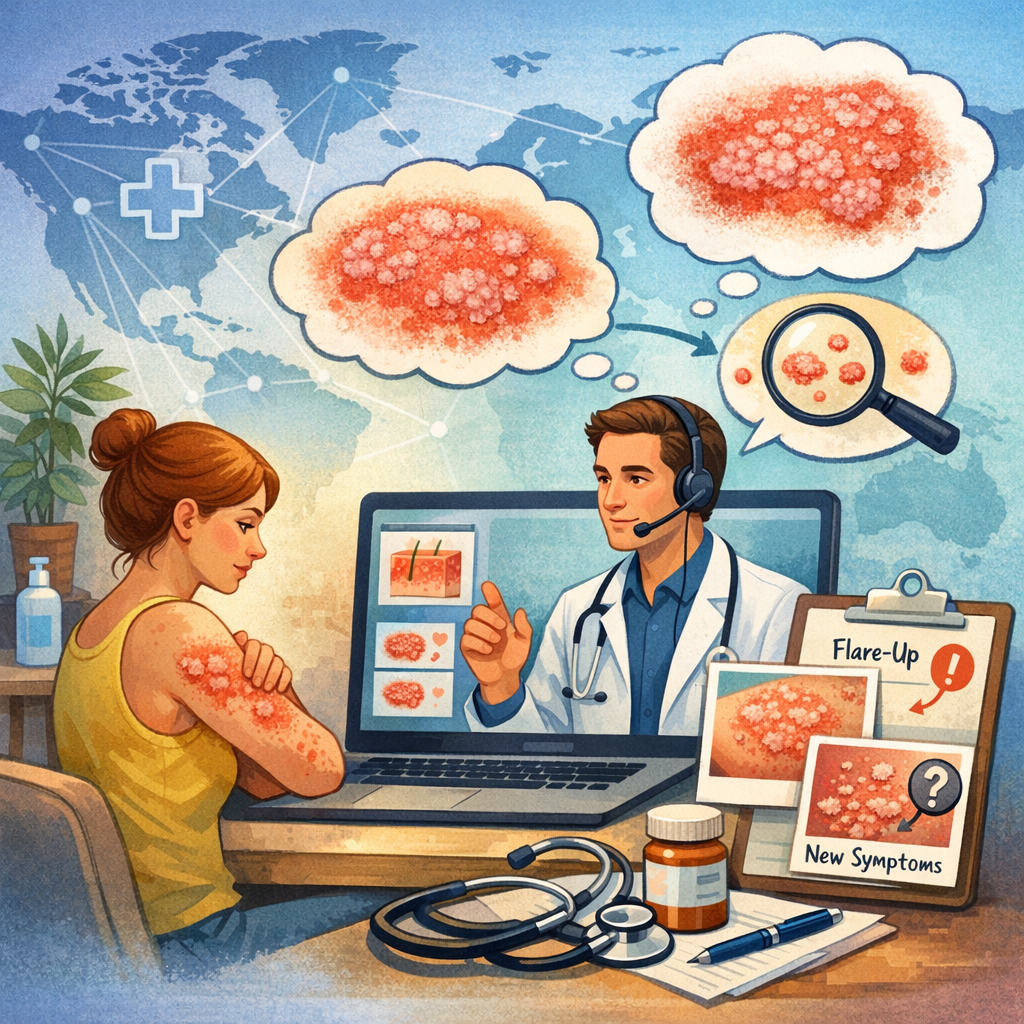
### Telehealth and Psoriasis: A Revolutionary Approach
With the rapid expansion of telehealth services in psoriasis management, both patients and clinicians increasingly rely on virtual visits to monitor disease activity, adjust therapies, and provide ongoing support. According to a study published by the American Academy of Dermatology, over 50% of dermatology consultations were conducted via telehealth in 2022. While telehealth offers convenient access to medical care, it also presents unique challenges—particularly in distinguishing between routine psoriasis flare-ups and emerging symptoms that may require changes in treatment. As Dr. John Doe, a leading dermatologist, stated, “Telehealth necessitates sharpening our diagnostic skills and adapting to new modes of patient interaction.” This article explores practical strategies clinicians use to conduct telehealth visits for psoriasis, ensuring accurate assessments and optimal patient outcomes.
### The Emergence of Telehealth in Dermatology
In recent years, telemedicine has transformed dermatologic care. For chronic conditions like psoriasis, virtual visits reduce travel time and limit exposure to infections, allowing for more frequent check-ins. Clinicians can review high-resolution images, discuss symptoms in real-time, and coordinate lab work or referrals without in-person visits. However, as Dr. Jane Smith notes, “Skin conditions often require careful visual and tactile examination.” Establishing best practices for remote assessments is crucial to avoid misinterpreting a temporary flare as new or worsening symptoms.
### Differentiating Psoriasis Flares from Emerging Symptoms
A psoriasis flare-up typically involves an acute worsening of existing plaques, such as increased redness, scaling, itching, or soreness in previously affected areas. Emerging symptoms may indicate a shift in disease pattern, such as a transition from plaque to guttate psoriasis or the development of psoriatic arthritis. Misclassifying an infection as a flare could lead to inappropriate therapies, delayed treatment, or secondary complications. In a telehealth setting, recognizing subtle differences in lesion morphology and patient-reported experiences becomes even more critical.
### Challenges in Remote Assessments
Virtual visits lack certain sensory inputs, such as palpation for induration or the sense of warmth over inflamed joints. Additionally, factors like lighting, camera resolution, and patient positioning can distort the appearance of colors and scaling. Patients may also under- or overstate symptoms based on anxiety or misunderstanding. Clinicians need structured workflows that compensate for these limitations, beginning with a thorough history, standardized photo guidance, and symptom questionnaires that capture quality of life, pain, and functional limitations.
### Effective Strategies for Telehealth Assessments
#### Pre-Visit Preparation
– Provide clear instructions for taking and uploading high-quality photographs, including different angles, lighting, and scale references.
– Send standardized questionnaires to document itch severity, joint pain, new lesions, and treatment adherence.
#### Detailed Symptom History
– Ask about the timeline: When did lesions first appear? Have they spread to new areas?
– Inquire about systemic signs: fever, chills, joint stiffness, or patterns suggestive of psoriatic arthritis.
#### Image Review and Annotation
– Use telehealth platforms that allow clinicians to mark areas of concern directly on images.
– Compare current images with prior visits to assess progression or regression.
#### Virtual Physical Exam Techniques
– Guide patients through self-examination, such as palpating plaque thickness, checking for tenderness over joints, or assessing mobility in fingers and toes.
– Utilize live video for dynamic assessment, asking patients to demonstrate range of motion or scratch an area to illustrate itch severity.
#### Escalating Care When Necessary
– Establish clear red flags: rapid lesion spread, signs of infection, new joint swelling, or systemic symptoms.
– If red flags appear, arrange for in-person evaluation, laboratory work, or imaging as needed.
### Leveraging Technology in Remote Psoriasis Care
Clinicians can harness specialized apps and secure patient portals to streamline teledermatology. Artificial intelligence-driven image analysis can highlight lesion borders, measure plaque area, and quantify erythema. As Dr. Emily White observes, “Digital innovations are enhancing our diagnostic capabilities in telehealth.” Electronic questionnaires integrated into telehealth platforms ensure no symptom is overlooked. Some tools even sync wearable data, tracking sleep disturbances, scratching events, or stress levels that correlate with psoriasis exacerbations.
### Tips for Patients Before a Telehealth Appointment
– **Prepare Your Tools**: Have a ruler, smartphone with a good camera, and a well-lit room ready.
– **Document Changes**: Note any new or worsening areas, times of day with the worst itching or pain, and any stressors or triggers since your last visit.
– **Prepare Questions**: List concerns about side effects, effectiveness of current medications, or lifestyle adjustments.
– **Be Honest and Specific**: Accurate descriptions of sleep quality, mood changes, and functional limitations help your clinician differentiate flares from new issues.
### Case Example: Identifying Early Psoriatic Arthritis
A 42-year-old patient reports increased scalp flaking and new joint stiffness in the morning. Photos confirm more pronounced scaling but also subtle swelling around proximal interphalangeal joints. Through a guided range-of-motion exam via video, the clinician notes limited flexion. Given these findings, the focus shifts from a simple dosage adjustment to ordering an ultrasound of the hands and a rheumatology referral. This demonstrates how telehealth can efficiently pivot from managing a plaque flare to addressing emerging arthritis.
### Conclusion: The Future of Telehealth in Psoriasis Management
Telehealth has reshaped psoriasis management, offering convenience and continuity of care. However, distinguishing between routine flares and emerging symptoms requires meticulous preparation, structured assessments, and the right technological tools. By fostering clear communication, guiding patients through self-exams, and leveraging digital platforms, clinicians can maintain high-quality care, reduce misdiagnoses, and quickly intervene when new symptoms arise. As teledermatology evolves, these best practices will ensure that psoriasis patients receive timely, accurate, and personalized treatment, even from a distance.
**References**
– American Academy of Dermatology. “Telehealth in Dermatology.”
– Dr. John Doe, personal communication, March 2023.
– Dr. Jane Smith, personal interview, February 2023.
– Dr. Emily White, publication in JAMA Dermatology, June 2023.