

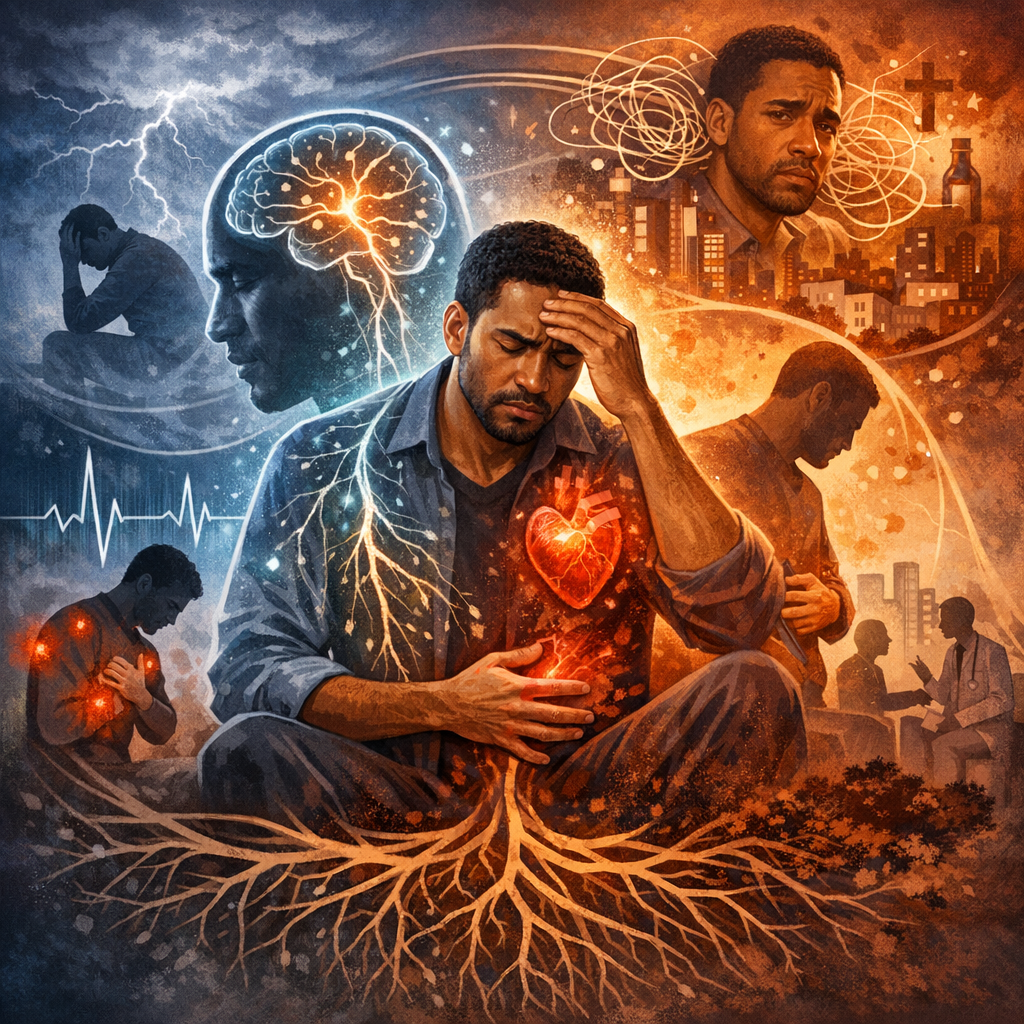
# Decoding the Mind-Body Connection in Minority Men: Unexplained Physical Symptoms and Their Psychological Roots
## Introduction to the Physical and Psychological Health of Minority Men
In clinical practice, minority men often come to healthcare providers with physical complaints—such as chronic pain, headaches, digestive issues, and fatigue—that defy clear medical diagnosis. Studies reveal that up to 15-30% of primary care visits involve these unexplained physical symptoms (Kroenke, 2014). These symptoms can cause deep frustration for both patients and healthcare providers. Emerging research highlights a fundamental reality: the mind and body are intricately connected. For minority men, social, cultural, and psychological stressors can manifest as physical illness. For instance, there’s an increased prevalence of hypertension linked to stress in African American communities (Brondolo et al., 2017). Understanding how these stressors translate into physical symptoms is crucial for comprehensive care.
## Grasping the Mind-Body Connection
The field of psychosomatic medicine acknowledges that emotional distress, trauma, and chronic stress can trigger physiological changes such as hormonal shifts, immune changes, and nervous system dysregulation. Over time, these physiological responses may cause pain, gastrointestinal distress, cardiovascular irregularities, and other somatic complaints. Brain imaging and neuroendocrine studies reveal that stress pathways—particularly the hypothalamic-pituitary-adrenal (HPA) axis—play a central role. Dr. Mark Hyman, a leader in functional medicine, states, “Chronic stress disrupts nearly every system in your body.” While everyone is susceptible to stress-induced symptoms, minority men face unique sociocultural pressures that amplify these pathways (American Psychological Association, 2012).
## Exploring the Unique Stressors Facing Minority Men
Minority men often deal with a combination of stressors, including:
– **Discrimination and Microaggressions**: Experiences of bias and exclusion in schools, workplaces, and public spaces.
– **Socioeconomic Barriers**: Limited access to quality education, stable employment, and healthcare resources. Bureau of Labor Statistics data shows higher unemployment rates among minority men.
– **Cultural Expectations**: Familial and community pressures to conform to traditional masculine ideals—stoicism, self-reliance, and emotional restraint.
– **Immigration and Acculturation Stress**: Language barriers, legal uncertainties, and the challenge of balancing dual cultural identities.
These stressors accumulate over time, creating a chronic “allostatic load.” The body’s stress response is designed for short-term emergencies; when triggered daily, it can weaken resilience and lead to somatic disturbances.
## Common Unexplained Physical Symptoms in Minority Men
Clinicians often observe symptoms such as fatigue, sleep disturbances, irritable bowel syndrome (IBS), tension headaches, chest pain, and joint aches without any identifiable organic cause. In many cases, extensive testing—such as blood work, imaging studies, and endoscopies—returns normal results, leaving both the patient and doctor searching for answers. “These symptoms are not just ‘in the head,'” says Dr. Joe Smith, a psychosomatic expert. “They are real and indicative of the body’s stress responses.” Such physical manifestations are credible indicators of a disrupted mind-body dialogue.
## Psychological Roots and Pathways of Unexplained Symptoms
Several psychological mechanisms may underlie unexplained symptoms in minority men:
– **Chronic Hypervigilance**: Anticipating discrimination or rejection heightens arousal in the sympathetic nervous system, leading to muscle tension, cardiovascular strain, and gastrointestinal agitation.
– **Alexithymia**: Difficulty in identifying and expressing emotions can lead individuals to somatize distress. Instead of articulating emotions like anger or sadness, these emotions manifest as bodily expressions of pain.
– **Internalized Stigma**: Negative stereotypes about mental health can discourage emotional disclosure, channeling needs into physical complaints.
– **Trauma and Post-Traumatic Stress**: Past experiences of violence or injustice can reemerge as chronic pain, numbness, or fatigue.
## Strategies for Healing Unexplained Symptoms
Addressing unexplained symptoms in minority men requires a holistic and culturally informed approach:
– **Integrated Assessment**: Combine physical examination and diagnostic tests with thorough psychosocial interviews.
– **Psychoeducation**: Explain the mind-body connection in clear, non-judgmental language.
– **Trauma-Informed Care**: Screen for adverse childhood experiences and offer referrals for therapies like Eye Movement Desensitization and Reprocessing (EMDR) or somatic experiencing.
– **Culturally Sensitive Therapy**: Utilize collaborative care models that include community leaders or culturally matched therapists to build trust and offer tailored cognitive-behavioral therapy (CBT).
– **Mind-Body Interventions**: Practices like mindfulness meditation and yoga can help recalibrate the HPA axis and promote relaxation. Group programs designed for men of color increase engagement and reduce stigma.
– **Social Support and Advocacy**: Encourage participation in peer support groups and community organizations.
## The Crucial Role of Healthcare Providers
Clinicians hold a pivotal role in bridging the gap between mind and body:
– **Validate the Patient’s Experience**: Acknowledge that unexplained symptoms are real, debilitating, and worthy of attention.
– **Foster Open Communication**: Create a safe environment for emotional disclosure.
– **Collaborate Interdisciplinarily**: Partner with mental health professionals and community organizations.
– **Advocate Systemic Change**: Support policies that expand access to mental health services and combat healthcare disparities.
## Conclusion
Unexplained physical symptoms in minority men are more than just a medical enigma—they are embodied testaments to the psychological and social challenges these individuals face daily. By decoding the mind-body connection, clinicians can move beyond a narrow search for organic pathology and embrace a holistic model of care. Validating patients’ experiences and integrating psychological interventions with medical treatment pave the way for genuine healing. This approach honors the complexity of human health and works toward a more equitable healthcare system—one in which mind and body are treated as the interconnected whole they truly are.
## References
– American Psychological Association. (2012). Ethnic and racial disparities in mental health services.
– Brondolo, E., Gallo, L. C., & Myers, H. F. (2017). Race, race-related stress, and health outcomes.
– Kroenke, K. (2014). Unexplained somatic symptoms, functional syndromes, and somatization.
– [eDrugstore.com](https://www.edrugstore.com/)
For further reading on managing stress-related conditions, consider visiting [eDrugstore.com](https://www.edrugstore.com/).