

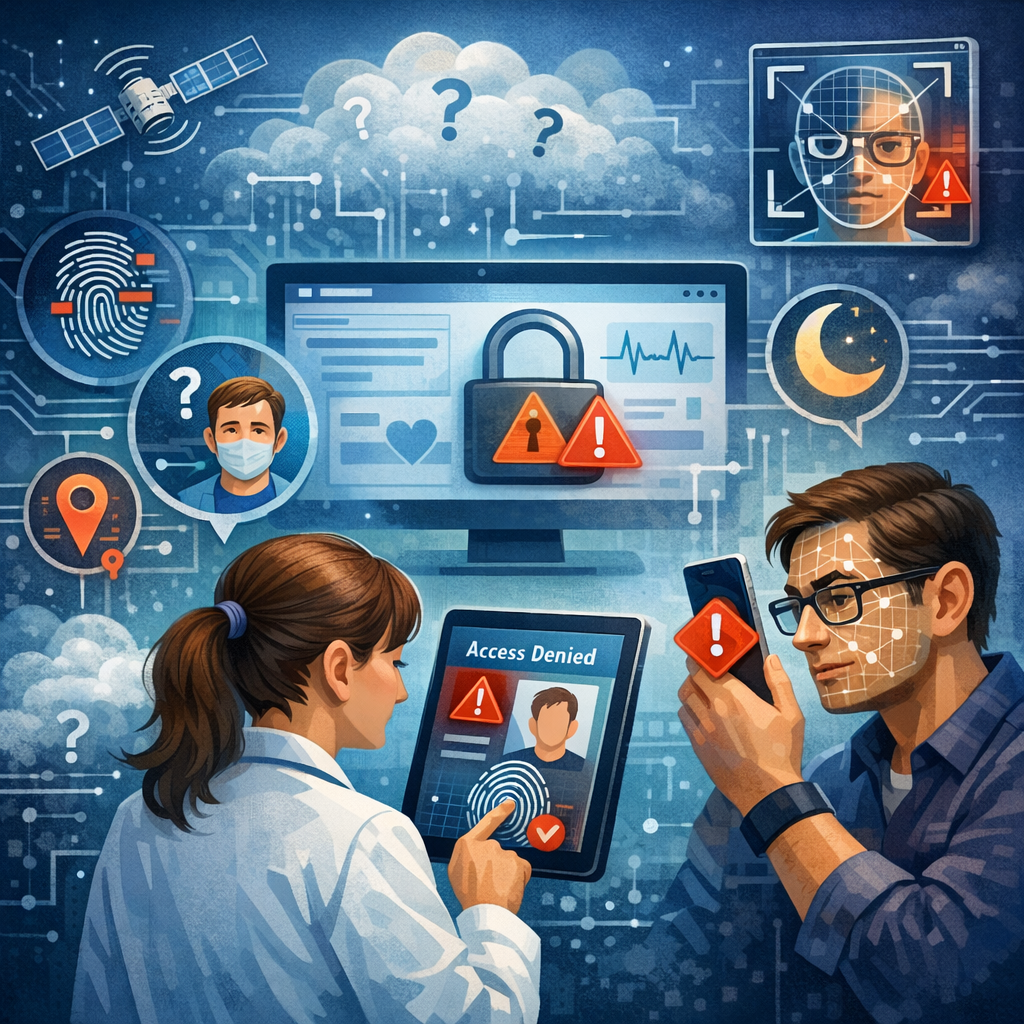
**Navigating Digital Health Anomalies: Understanding Uncommon Causes of Failed Biometric Logins in Patient Portals**
**Introduction**
Biometric authentication has transformed the landscape of patient portal security, using fingerprints, facial recognition, and iris scans to streamline the login process and safeguard sensitive health information. Despite the advancements offered by these technologies, challenges can arise. Situations may include a fingerprint failing to scan, facial recognition rejecting an authentic user, or an iris pattern not matching. While hardware malfunctions or poor image quality are typical issues, various less common factors can also disrupt biometric logins. This article delves into these unusual causes and offers advice for healthcare IT teams and administrators to minimize disruptions.
### The Benefits and Challenges of Biometric Security in Healthcare
Biometric security is widely celebrated for its advantages:
– **Convenience**: Users can bypass traditional passwords and PINs.
– **Enhanced Protection**: Biometrics are harder to steal or replicate compared to conventional credentials.
– **Auditability**: Each login attempt is tied to a unique biometric signature.
Despite these benefits, real-world deployments can experience false rejections, with legitimate users being denied access. According to a study in the Journal of Medical Internet Research, false rejection rates can range from 1% to 5%. These instances can frustrate users and lead to increased support tickets, potentially delaying urgent care.
### Common Causes of Biometric Failures
Before exploring rarer causes, understanding common issues can be helpful:
– **Poor Capture Conditions**: Factors like blurry facial images, low lighting, or dirty fingerprint sensors.
– **System Calibration Errors**: Mistakes in sensitivity threshold configurations.
– **Wear and Tear**: Sensor scratches or aging hardware.
– **User Error**: Incorrect finger placement or facial misalignment.
Once these typical challenges are ruled out, deeper anomalies might be considered.
### Skin Conditions and Dermatological Factors
Patients suffering from eczema, psoriasis, or dermatitis may experience changes in skin texture over time. Even mild dryness or calluses from manual labor can distort fingerprint ridge details. Treatments like chemical peels or laser therapy might temporarily alter surface patterns, leading to biometric rejection. Healthcare providers should consider:
– Offering alternative enrollment sessions post-treatment.
– Educating on using moisturizers or barrier creams to maintain consistent skin conditions.
– Implementing fallback methods like passwords or tokens during flare-ups.
### Environmental Influences and Wearables
Products such as hand sanitizers, lotions, and gloves can impact sensor readings. During the COVID-19 pandemic, frequent use of alcohol-based sanitizers often left residual films on fingers. Cold weather may cause skin tissue to contract, while humidity causes perspiring that blurs minutiae. Additionally, smart rings or fitness bands with sensors can interfere with iris scanners by reflecting infrared light. Mitigation strategies include:
– Installing quick-dry hand wipes near scanners.
– Calibrating systems for broader temperature and humidity ranges.
– Advising the removal of wearable devices prior to scanning.
### Aging and Biometric Variability
Biometric traits can change over time. Fingerprint ridges might soften and fade with decreasing skin elasticity. Facial features may shift due to weight changes, medical procedures, or natural aging. Even iris patterns can change slightly due to pupil dilation or cataract surgery. Organizations should:
– Initiate periodic re-enrollment, such as every two years.
– Employ adaptive matching algorithms to account for gradual changes.
– Combine multiple authentication forms like fingerprints, facial recognition, or voiceprints.
### Data Integrity and False Rejection Rate Anomalies
Sometimes, the issue lies within data integrity. Corrupted templates or database synchronization errors can increase false rejection rates. Legacy portals that aren’t updated may suffer from index fragmentation or race conditions during high login volumes. To ensure data integrity:
– Employ end-to-end encryption and hashing for template storage.
– Schedule regular database maintenance and backups.
– Monitor indicators like False Rejection Rate (FRR) and False Acceptance Rate (FAR) in real-time.
### Integration Bugs and Software Updates
Biometric solutions often integrate with identity management platforms, mobile apps, and cloud services. A recent software update or API version mismatch might disrupt communication pathways, leading to silent failures. Best practices include:
– Performing rollback testing in a staging environment before going live.
– Maintaining detailed change logs for every update.
– Using feature flags to toggle functionality without disrupting users.
### Psychological and Behavioral Factors
Login anxiety from previous rejections can inadvertently increase failure rates. Patients fearing lockouts may alter behaviors unconsciously, such as moving too close to cameras, pressing fingers too hard, or rushing the process. To reduce stress:
– Provide on-screen prompts like “Hold your finger gently and stay still.”
– Offer clear fallback messaging such as “Forgot biometric? Use your password.”
– Train staff to provide empathetic, patient-centered support.
### Mitigation Strategies: Best Practices for Healthcare IT
– **Hybrid Authentication**: Combine biometrics with one-time passcodes or knowledge-based questions.
– **Continuous Authentication**: Use passive monitoring methods for ongoing verification.
– **Patient Education**: Share guides on optimal scanning practices.
– **Accessibility Considerations**: Offer alternatives for users with disabilities or severe dermatological issues.
– **Incident Tracking**: Analyze failures to identify emerging patterns.
### Future Directions: AI and Adaptive Algorithms
Artificial intelligence promises self-regulating systems that adjust thresholds and retrain models using real-world performance data. Deep learning can discern subtle biometric changes, distinguishing benign variability from fraudulent attempts. As these technologies evolve, healthcare organizations should:
– Pilot machine-learning platforms using anonymized datasets.
– Consult with security and privacy experts for algorithm validation.
– Share failure metrics across the industry for best-practice benchmarks.
**Conclusion**
Biometric authentication is a powerful tool enhancing security and user experience within patient portals. However, advanced systems can still encounter unexpected challenges from skin conditions and environmental factors to software bugs and human psychology. By identifying these uncommon causes of failed logins, healthcare IT teams can employ targeted strategies to ensure seamless access and robust protection. As technology progresses, embracing adaptive AI solutions and fostering industry collaboration will be crucial for developing resilient digital health ecosystems.