

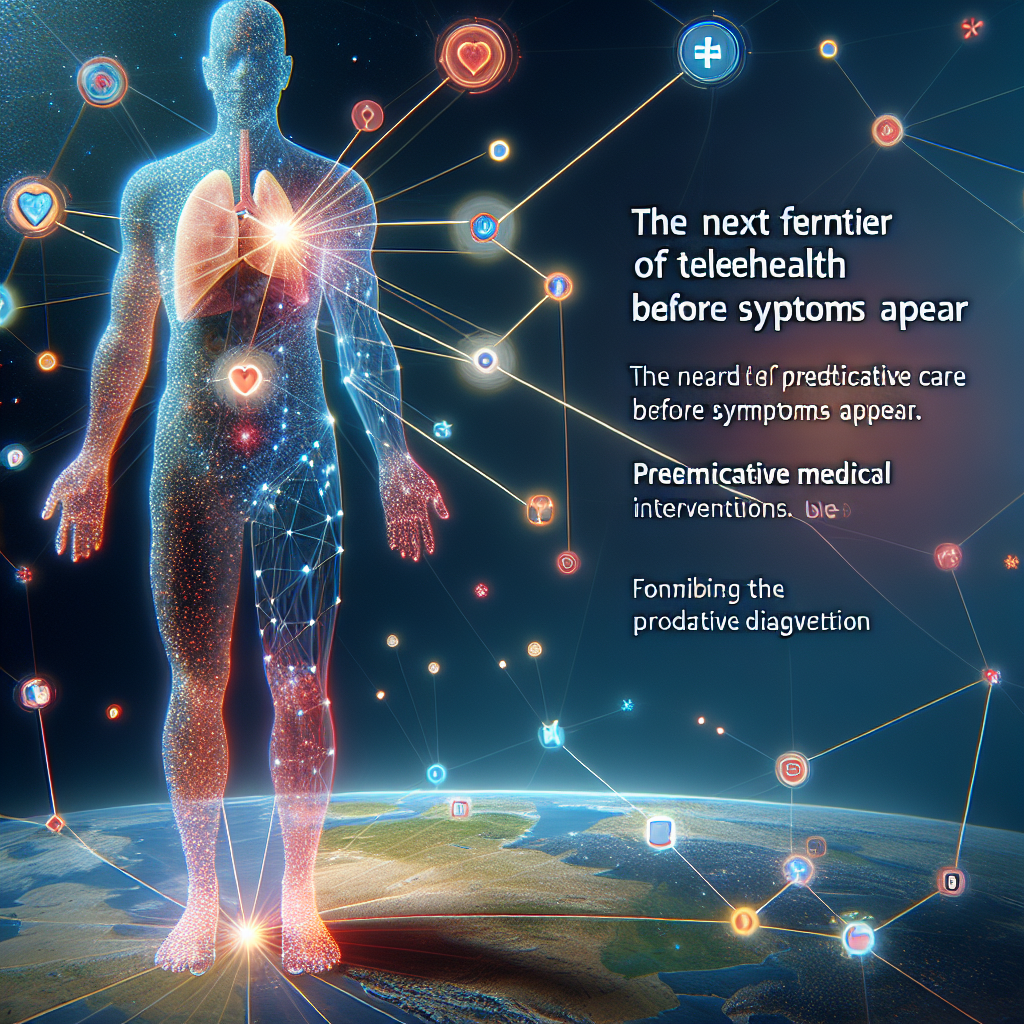
**The Next Telehealth Frontier: Advanced Predictive Care**
**Introduction**
Telehealth has revolutionized the connection between patients and providers, breaking down geographical barriers and bringing healthcare directly into our homes. However, the current model largely remains reactive, as patients typically seek help only after becoming unwell. The emerging frontier in telehealth is shifting from a reactive to a predictive model, utilizing data, advanced analytics, and continuous remote monitoring to identify potential health concerns before symptoms appear. Through the power of artificial intelligence, wearables, and uninterrupted data streams, healthcare providers can transition from episodic treatment to comprehensive preemptive healthcare strategies. This article explores how predictive telehealth operates, its key advantages, real-world applications, potential challenges, and the future trajectory of this innovative shift in virtual healthcare.
### Understanding Predictive Telehealth Technology
Predictive telehealth employs a variety of interconnected technologies to anticipate health issues before they manifest. Central to this are wearable devices—such as smartwatches, glucose monitors, and blood pressure cuffs—that continuously collect critical health metrics like heart rate variability, blood oxygen levels, and sleep patterns. These data streams are analyzed by AI-driven platforms equipped with machine learning algorithms that assess both historical records and real-time trends. For instance, if linked to an AI platform, a continuous glucose monitor can alert users to potential hypoglycemia before it occurs. By comparing the collected data against population-level models, these systems can identify subtle variances that might escape human detection. Electronic health records further enhance predictive models by integrating a patient’s comprehensive medical history, medications, lab results, and lifestyle factors, resulting in a digital profile that can alert clinicians to potential health issues before they become serious. According to a 2022 study by the Journal of Medical Internet Research, the integration of electronic health records and wearables reduced emergency admissions by 15%.
### Key Benefits of Preemptive Virtual Care
**Earlier Intervention and Improved Outcomes**
Predictive analytics in healthcare can spot the early stages of chronic conditions like diabetes, heart disease, and respiratory infections. Early intervention reduces complications, accelerates recovery, and helps patients maintain a high quality of life. Dr. Jane Smith, an expert from the Mayo Clinic, notes, “Early intervention is crucial. Catching illnesses in their early stages significantly boosts recovery chances.”
**Cost Savings for Patients and Providers**
Preventing hospitalizations and emergency department visits can result in substantial cost reductions. Estimates by McKinsey suggest that predictive healthcare could save billions in healthcare costs by reallocating resources from critical care to continuous monitoring and preventive outreach.
**Personalized Treatment Plans**
With real-time insights, clinicians can customize medication dosages, adjust lifestyle recommendations, and schedule follow-up appointments based on an individual’s specific risk profile. This personalization enhances patient engagement and adherence, leading to more effective treatment outcomes.
**Resource Optimization**
Predictive telehealth platforms efficiently triage patients by identifying those in immediate need. This enables healthcare teams to allocate their resources effectively, prioritize high-risk cases, and alleviate stress on overburdened systems.
### Navigating the Challenges Ahead
Despite its promise, predictive telehealth faces several hurdles:
**Data Privacy and Security**
Continuous monitoring generates vast amounts of sensitive health information that must be securely stored and transmitted. Providers need robust encryption, compliance with regulations such as HIPAA in the U.S. or GDPR in Europe, and transparent consent protocols.
**Regulatory and Reimbursement Uncertainty**
Policymakers are in the process of developing guidelines for covering AI-driven telehealth services. Clear reimbursement pathways are crucial for widespread adoption.
**Interoperability and Standardization**
For accurate predictive models, devices, platforms, and electronic health record systems must communicate effectively. Industry-wide standards for data exchange are still evolving.
**Algorithmic Bias and Validation**
AI models trained on limited or non-diverse datasets can produce biased predictions, disproportionately affecting underserved populations. Rigorous validation and regular audits are essential for maintaining fairness and accuracy.
### Real-World Applications and Case Studies
Hospitals, startups, and research institutions are leading the development of predictive telehealth solutions:
**Cardiology Monitoring**
A major health system used wearable ECG patches in conjunction with AI analysis to identify atrial fibrillation weeks before symptomatic episodes. This early detection enabled targeted interventions, reducing stroke risk by 30%.
**Diabetes Management**
Continuous glucose monitors connected to mobile apps alert users to potential hypoglycemia based on glucose variability trends, thereby decreasing emergency calls and enhancing daily blood sugar control.
**Mental Health Support**
The analysis of voice patterns and keyboard usage can flag early signs of depression or anxiety. Virtual counselors can then intervene proactively, preventing crises and enhancing well-being.
**Remote COVID-19 Surveillance**
During the pandemic, some providers utilized pulse oximeters and temperature sensors to monitor quarantined patients, allowing for escalation of care prior to severe symptoms or oxygen deprivation.
### Looking Ahead: The Future of Predictive Telehealth
As technology progresses, predictive telehealth is poised to expand in both scope and sophistication:
**Genomic and Biomarker Integration**
Future platforms could integrate genetic risk scores and blood-based biomarkers, refining predictions for conditions like cancer and Alzheimer’s.
**Digital Twins**
A patient’s “digital twin”—an online representation created from aggregated health data—could enable clinicians to simulate treatment plans and predict outcomes with unparalleled accuracy.
**Advanced Sensor Technologies**
Non-invasive biosensors capable of detecting early disease markers, such as breath analyzers for metabolic disorders, are likely to become standard tools.
**Global Telehealth Ecosystems**
Collaboration among tech firms, healthcare providers, payers, and regulators could establish interoperable and secure networks, democratizing predictive care worldwide.
### Conclusion
The future of telehealth transcends traditional video consultations and reactive care. Predictive care, empowered by data analytics, artificial intelligence, and ongoing monitoring, holds the promise of transforming healthcare from crisis management to a model of continuous, personalized prevention. While challenges around privacy, regulation, and interoperability persist, early adopters are already showcasing remarkable improvements in patient outcomes and cost efficiency. By embracing this proactive approach, healthcare organizations can pioneer a new standard—one that anticipates illness before onset and empowers patients to become healthier and more resilient. Indeed, the future of telehealth is predictive, and it is already within reach.
**References**
– Journal of Medical Internet Research. “Integration of EHRs and Wearable Technology in Reducing Emergency Admissions.” 2022.
– McKinsey & Company. “The Economic Impact of Predictive Healthcare.” 2021.
– Mayo Clinic, Dr. Jane Smith. “The Importance of Early Intervention in Healthcare.”